Basic 101 on bilge pumps?

walterv

Moderator
Member
Joined
Jan 11, 2004
RO Number
12640
Messages
6,381
My entire 40 years of boating, never played with or replaced a bilge pump. Probably needed to, but never checked them :)

So here is the deal,

I need to know how the "float Switch" is wired, as opposed to the manual use with the switch.

Logic would tell me the pump has a separate power + feed to override the float? What I see is that is not the case and am thinking all power seems to go through the float. Som if the float is bad, you cannot manually override.

Specific point!
Had water in the bilge, way above where the float should have kicked on. So use the manual switch, and it still does not pump. I did not have a volt meter with me so assumed the pump was bad. I removed the pump, brought it home and hooked up, a power source and the pump works.

Guess it is the float???

Walter
 
Bilge Pump in our Sea Ray is wired as follows:

1. The Instrument Panel Switch powers the Pump independently from the Float Switch.
2. The Instrument Panel Switch gets its power from the Battery Disconnect Switch. So, Battery Off, Switch will not run Bilge Pump.
3. The Float Switch is wired direct to Battery.
4. Therefore the Float Switch can run the Pump even if battery is Off.

So in my opinion, the bilge pump is not wired correctly. Also, if you didn't have a meter or test light to check for voltage... Float or Instrument panel Switch could be bad. Or fuse blown, or failed connection
 
J-D pretty much summed it up! Without a meter it is very hard to know what the problem is. I have replaced every pump on my boat some more then once I have replace a couple of the floats but not all of them.
 
Typically the float switches go bad before the pumps, so not surprising the pump worked. How many pumps and do they all have separate manual switches?
 
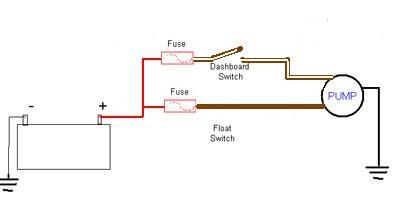
Battery-drawing-Bilgepump-v3.jpg
 
For ours, add a Perko Switch in the vertical part of the "+" wire, above the splice to the Float Switch Fuse. Ours can't be turned on from the Dashboard Switch if the Perko Switch is Off.
 
Walter,
You drew this for me and it worked already. Remember that new pump I installed. It's exactly what is above.
Now and then this happens on my boat to my pump that came with boat and it's one of two issues. One is the reset button. I have resets for all powered items.
Other issues is rot. The wires for pump usually run too low and get wet. I remove covering and keep following and I will usually find a place where it's rotted. I fix that and it works. Been down this road too many times. Pulled pump. Pulled float. Bought new. Only to find out it's the wires.
 
quote:

Originally posted by Cam

quote:

Originally posted by Radioactive

Battery-drawing-Bilgepump-v3.jpg


Bingo. We have a winner here.


Why 2 fuses ??

What is protecting the wire from the battery to the first and second fuses wired that way ??

edit.......the one thing correct with that drawing is the color of the wire from the battery to the fuses....being RED indicates fire.
 
Feel free to add another fuse.

Yes. There can be another fuse between the battery connection and the location where the wires split. ( OR that could be the only fuse... ) What is drawn is what I have found to be most common as "OEM". This, of course, does not make it best, nor even right. But it is what most boaters would be likely to discover.

BTW: There are those who will argue that the bilge pump should not be fused. I am not one of those. In my case, I used the above drawing. But the distance from the battery to the "distribution point" was less than one foot. I am not certain a "main bus" fuse is needed in this case. Note that if there was more than one pump being serviced by this feed line, a fuse such as you would describe would be needed.

edit:

You are free to provide your own drawing. If you wish to discredit this one, then please offer a substitute drawing.
 
It really depends on how the builder installed the pumps.

In most cases you have two wires feeding the pump, one thru the float switch and one thru a manual switch. Both will have breakers (or fuses) to protect both lines.

Since the float switch line should be connected independently of the battery switch, some builders install a number of circuit breakers near the battery switch. Check there.

On some instal the float switch may be ortotctd by an inline fuse near the battery terminal.

Indeed float switches usually fail before the pumps...
 
quote:

Originally posted by Double D

quote:

Originally posted by Cam

quote:

Originally posted by Radioactive

Battery-drawing-Bilgepump-v3.jpg


Bingo. We have a winner here.


Why 2 fuses ??

What is protecting the wire from the battery to the first and second fuses wired that way ??

edit.......the one thing correct with that drawing is the color of the wire from the battery to the fuses....being RED indicates fire.


Mine is wired the same way I have two feeds going to my breaker panels, The float switches are connected to a reset switch and the manual switched are on a standard breaker. There is no unprotected feed from the battery both connections are tied in at the panel. As the pumps get old they draw more power and trip the breakers & I know it's time replace the pumps. I keep at least one spare pump on board at all times.
 
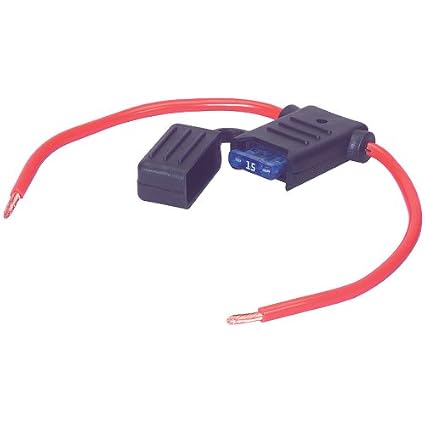
I wondered how ours worked till I noticed a wire from one of the batteries right to the Float Switch. Had an in-line glass fuse. Both fuse and holder fell apart a couple times. Replaced with an ATO fuse like the main fuse panel uses, and a new holder like this. Been OK since.
41Xm%2Bgp0BtL._SX425_.jpg
 
quote:

Originally posted by CurrentSea

Walter,
You drew this for me and it worked already. Remember that new pump I installed. It's exactly what is above.
Now and then this happens on my boat to my pump that came with boat and it's one of two issues. One is the reset button. I have resets for all powered items.
Other issues is rot. The wires for pump usually run too low and get wet. I remove covering and keep following and I will usually find a place where it's rotted. I fix that and it works. Been down this road too many times. Pulled pump. Pulled float. Bought new. Only to find out it's the wires.


Wires just do not rot.... Even after years in bilge water. The key is to keep the splices, connectors etc dry and protected. Unfortunately some people and builders take short cut and go hide a connector wrapped in electrical tape too low where it gets wet and/or use un tinned wire

Ideally, the wires from the pump and float switch should go straight up to a terminal block installed as high as possible with shrink terminals

This way, not only are the connections high above water but you can also troubleshot issues without having to disconnect anything
 
quote:

Originally posted by Radioactive

Feel free to add another fuse.

Yes. There can be another fuse between the battery connection and the location where the wires split. ( OR that could be the only fuse... ) What is drawn is what I have found to be most common as "OEM". This, of course, does not make it best, nor even right. But it is what most boaters would be likely to discover.

BTW: There are those who will argue that the bilge pump should not be fused. I am not one of those. In my case, I used the above drawing. But the distance from the battery to the "distribution point" was less than one foot. I am not certain a "main bus" fuse is needed in this case. Note that if there was more than one pump being serviced by this feed line, a fuse such as you would describe would be needed.

edit:

You are free to provide your own drawing. If you wish to discredit this one, then please offer a substitute drawing.


I don't possess the computer skills to do a drawing like yours......but

The way your drawing shows.....you could have 30/40/50 feet ( depending on the size of the vessel ) of unprotected /un-fused wire from the battery in the engine room to the fuse/switch on the dashboard.
IMO the best way to wire the system would be install ONE fuse directly off the battery large enough to carry the load of the pump(s)...any indicator lights you may use and wire resistance ...no need for THREE fuses that add potential points of failure. Or if you have room in the manufacture's fuse panel for an added circuit.... feed from that point. Its fairly simple.
 
I really disagree on using one large fuse to protect multiple items as the larger fuse or breaker may not trip. Circuit protection needs to be sized right, not oversized.

I recently had this issue with the thin wire on an LED nav light which shorted out. The breaker was oversized to protect all nav light fixtures and didn't trip even though the wire was melting and smoking.
The right way to do it is to tap power at the U switched terminal of the battery switch install a small panel next to it with a breaker for each pump. I just doth like inline fuse at the battery terminal... If you have multiple pumps you have multiple fuses and connection which sooner or later someone will forget to reconnect when replacing batteries
 
If the single fuse is properly sized it will protect the circuit. I don't see the need for multiple fuses on any one circuit. Just like in house wiring there is one breaker per circuit.....you never have a branch circuit in the panel box ....then another fuse before each device. Makes no sense.
 
Thanks,
Yeah dave, I do remember, but this looks different on my boat, gotta look again.
John,
I have three pumps forward, mid and stern.

I will check next weekend and get back to you all, thanks for confirming what I thought but gotta look a little deeper. What I also don't like on my boat is my manual override switch for the bilge is a "momentary" switch. I would like to replace that with one I flip and it says on till I flip it off.

I have a laundry list of maintenance, add ons, and repairs I will be doing this winter. I have heat in the boat and am looking forward to doing this all.

Walter
 
If you go to a manual on, make sure you have a light to notify you it is in the on position. That has saved my bacon more than once when the grandchildren "visit the helm". Do not install one of those "auto-off-on" switches. Accident waiting to happen. Wire it up so when the switch is off, the pump operates off the float switch, if the switch is on, the pump is on.

Here is my views. Install the biggest pump practical. Spare no wire sizing, I usually go up one size from the chart because as it ages it will increase in resistance. Properly fuse to protect the thinnest wire (usually the one fitted to the pump). Do not use reducers on the hose. Same size all the way from the pump to thru hull.

As for bilge pump switches I think the Ultra is the best switch hands down. All electrical is epoxy encapsulated, just one thing to move is the donut. Does not easily foul. Just about all the cruising forums agree. I have them on all my pumps.

http://www.tefgel.com/contain.php?param=pumpswitch_price#
 
I added one of those electronic switches. It senses water. Similiar to water witch. Works great. Nothing to foul or move.
 
Back
Top