
Battery charger issue?

nyc_bob

Member
Member
Joined
Jun 13, 2010
RO Number
32179
Messages
74
Here is the situation...

Was at the boat last night, plugged into shore power and everything A-OK. Batteries were reading ~13.4 volts. When I left the boat, everything was turned off except for the automatic bilge pump and the battery charger.

I return to the boat about 10 hours later and my carbon monoxide detector is going off with a reading of ~220. Also notice a somewhat sour smell in the boat. Thirdly, the battery voltage on my panel was reading 12.5 volts - a full volt lower than last night. I took the CO detector off the boat, the reading on the detector starts falling and alarm goes off. I also disconnected shore power just in case.

I was thinking there was a problem with the CO detector so I put it back in the cabin and it goes off again within a minute. I then bring it to fresh air and it goes back to zero. I then open the engine hatch and put it below deck and it goes off again. Again it clears after being put in fresh air.

Since the problem isn't with the CO detector, I'm thinking the problem lies in the battery charger. A peek at it doesn't show anything unusual. The charger is a Promatic 30-3 and is at least 10 years old, it charges one car size battery(generator), 2 car size batteries (engines), and the big house battery which is about the size of 2 car batteries. Other than the generator, the batteries are about 3 years old.

Just as some additional info (1)the marina lost power at my power pedestal last week and house battery went down to about 10 volts and (2)I topped off all batteries with distilled water about 3 weeks ago.

The only other piece of electrical equipment that I'm assuming gets powered was an Acme General Purpose Transformer - not sure what this is for I guess to convert the 240 dockside to 120 onboard.

Right now the boat is sitting at the dock, not plugged into shore power with only the automatic bilge pumps powered on.

What do you guys think? Battery charger? Transformer? Kind of afraid to run anything on the boat until this gets sorted.

Thanks
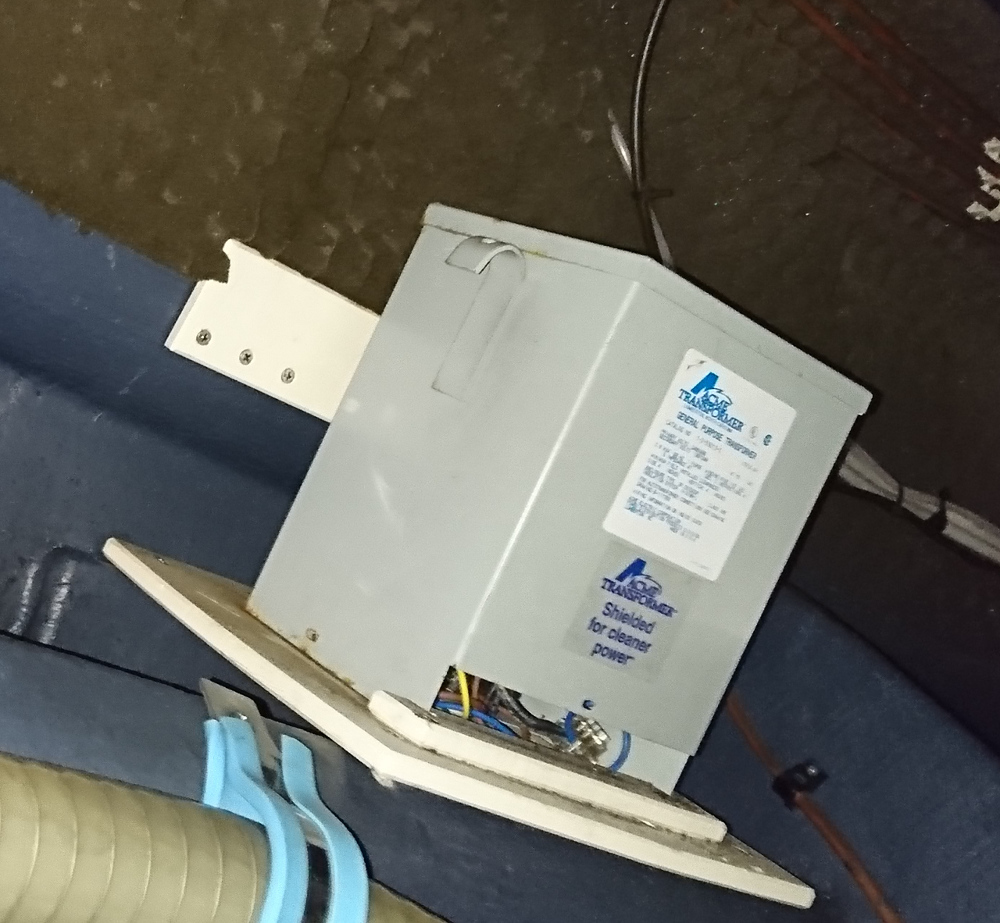
transformer.jpg


charger.jpg
 
Check the batteries. Whenever I ve had a sulfur smell inside the boat it was always when a battery went bad and vented out
I guess a bad charger could be cooking batteries.

One issue maybe the different sizes of batteries you are using with a dumb charger. Check the batteries for bulging and check the voltage at the terminals

Pro mariner is a good brand and nowadays i d really upgrade to a modern smart charger. Not that expensive

No idea what that transformer is for. It doesn't look like an isolation transformer. no need to use a transformer to convert 240 to 120 since 240 is actually two 120 legs
 
10 volts is very, VERY low (like way past a dead battery). What was running to take your house battery down that low?

I'm with Pascal on the point that ProMariner makes some great "smart" chargers" and you should upgrade your system IMO. What that "transformer" is for boggles the mind. It won't be that much to do to take your boat up to ABYC standards (although you may need all new batteries after the gassing and low voltage).
 
Thanks PascalG and mixman.

Heck if I know what the transformer does. Boat is Italian, maybe something European? It has a 50amp power cord but generally run a splitter into 2 30amp power cords.
EDIT -- Found out what the transformer does
Transformer is an isolation transformer and is a piece of safety equipment that seems like it should be standard on any boat. Did some googling and it seems like many Hatteras yachts have them. Here are a couple of links describing how they work and why you would want one on your boat:
http://www.boatus.com/seaworthy/magazine/2015/july/isolation-transformers.asp

https://www.passagemaker.com/technical/the-ins-and-outs-of-shorepower-transformers

I'm glad you guys mentioned "modern" battery chargers, I was wondering how up to date the technology was in this charger.

Definitely checking out more modern battery chargers, I'm guessing that the hardest part of hooking one up would be just getting my body into the tiny space. Replace with another 30amp/3bank charger or go for a 40 while I'm in there anyway?

When I checked the batteries a couple of weeks ago with a basic PepBoys/Autozone hygrometer all cells were in the OK range. Never bothered to check the voltage directly since my panel shows the voltage. I'll check with both a hygrometer and a voltmeter and look at the physical condition of the batteries when I get back to town on Monday. Hopefully the 8D is good, I don't look forward to pulling that one out but it might be a good time to replace it with three group 24 batteries (same physical size, lighter weight but a little more work to maintain) Good or bad idea?

If the water levels of the batteries are very low when I check, should I just assume that they are fried?

mixman - The fridge and water pump were switched on for a couple of days after the pedestal power went out so I guess that could have drawn the power down. I thought that there was a system to kill the power to everything except the bilge pumps if power went below a certain threshold. I guess not.

Regarding the CO monitor going off, a little research shows that hydrogen gas will set off a CO monitor:

http://www.firehouse.com/article/10518243/the-unexpected-golf-cart-hazard

and

https://hawkenvironmental.com/hydrogen-gas-can-create-false-reading-carbon-monoxide-alarms/
 
I've seen marine transformers and agree that they're a very good idea. I've never seen an Acme one used on a boat and I do not think Acme markets them for marine use. But, again, I agree that they're a good idea. I use something similar to this:

67030.jpg


To test your lead acid flooded batteries:

Check electrolyte level.
Charge fully.
Isolate batteries from each other (or at least each bank of batteries from other batteries/banks).
Allow to rest for 24 hours without any load on them.
Check voltage.

Ideally you'd like to see 12.7v for a 12v battery. Here's a very good article with a chart:

https://www.emarineinc.com/Batteries-Maintenance-101

Once you get that figured out (no sense replacing batteries until you're sure they're bad) then it will be time to size your new charger. Generally, the more amps, the better, but also there's no sense over-sizing a charger as it will be wasted money. Under-sizing will slow charging time. I'd need to know more details about the actually batteries in your different banks to give my two cents on a new charger (especially the house bank - how many amp hours are those batteries and what group size are they?).
 
Most likely suspect is a battery especially if you have two in parallel. Charging a bad battery often results in overheating, venting and stink. paralleled batteries make it worse and the good one dumps charge into the bad one at a very fast rate.
 
Great article Kurt. Looks like I have some work ahead of me on Monday. I guess by "charge fully" - you mean until charged or until they start boiling?

Interesting that the first place I googled about Acme transformers on boats sent me to a Hatteras forum seems to have been standard equipment for a bunch of models. It's a pretty big piece of equipment to have onboard but if it's good enough for Hatteras, it's good enough for me. It doesn't surprise me though - the boat is from a medium sized manufacturer (Cranchi) that builds some nice stuff, the hull is kevlar reinforced and even has some sort of separate cooling system for the shafts which surprised my marina manager.

These are the batteries on the boat:

Generator battery (5+ years old):
UltraPower 1024M
Description: 12V Marine Starting Battery
ULTRAPOWER Branded Marine Starting Battery – 12 Volt (Equivalent to Interstate Battery 24M-XHD)
Battery Part Number: 1024M
BCI Group Size: 24M
C.C.A. rb2@gr5t 0’F: 800
M.C.A. rb2@gr5t 32’F: 1000
RES CAP rb2@gr5t 25 Amps: 115
L/W/H: 10.25” x 7.13” x 9.88”

Starting Battery:
3 pc Interstate 24M-XHD's (installed 07/2014)
Product ID: 24M-XHD
Cranking Amps: 1000
Cold Cranking Amps: 800
Voltage: 12
Termination: Common Code M
Weight (lbs): 44.6
Width (in): 6.88
Length (in): 11.00
Height (in): 9.50
ReserveCapacity-25: 135.00
WET/DRY: W

House Battery:
UltraPower EV8D (installed 07/2014)
CCA rb2@gr5t 0: 1400
MCA rb2@gr5t 32: 1750
Res Cap rb2@gr5t25Amp: 450
20 hr rate: 225
Dim: 20.75L x 11W x 10H

If I do need to replace the house 8D, I'd probable replace with three Interstate 24M-XHD
 
Assuming those are wet cells types have you used a hydrometer to check the cells?
 
quote:

Originally posted by pdecat

Most likely suspect is a battery especially if you have two in parallel. Charging a bad battery often results in overheating, venting and stink. paralleled batteries make it worse and the good one dumps charge into the bad one at a very fast rate.


Exactly. He'll have to further isolate batteries if one bank shows as low.
 
quote:

Originally posted by nyc_bob

Great article Kurt. Looks like I have some work ahead of me on Monday. I guess by "charge fully" - you mean until charged or until they start boiling?


"Full" meaning 13.2-13.4 floating voltage. If you've got a bad battery that bank may not be able to make it to float as it will just be gassing off electrolyte. If this were my boat, with that charger, I'd turn it one, spend a few hours doing boat chores, then shut it down and measure resting voltage the next day. The bad battery/bank should stick out from the rest when you put a voltmeter on it.

quote:

Interesting that the first place I googled about Acme transformers on boats sent me to a Hatteras forum seems to have been standard equipment for a bunch of models. It's a pretty big piece of equipment to have onboard but if it's good enough for Hatteras, it's good enough for me. It doesn't surprise me though - the boat is from a medium sized manufacturer (Cranchi) that builds some nice stuff, the hull is kevlar reinforced and even has some sort of separate cooling system for the shafts which surprised my marina manager.


My power cat was made in Poland. I've got Kevlar, crush zones, positive flotation foam, all kinds of neat "European" things. They do some different things over there for sure (like wiring running lights wrong and non-crimped propane lines!).

quote:

These are the batteries on the boat:


Depending on how much you drain that house battery/bank would determine how many amps I would personally want in a charger. Off the top of my head I think you'd be fine with a newer "smart charger" in the 40 to 60-amp range (If it were me I'd likely go with 50-60 amps). I like redundancy so I've got two 40-amp chargers on my power can and 60 and 50 amp chargers on my trawler. My brand of preference is ProMariner due to the fact that they make good products and always take care of their customers (if you have a bad unit out of warranty, they'll give you a great deal on a new unit to replace it).

This is the line I have on both boats in 40 and 50-amp versions:

http://www.promariner.com/en/products/dry-mount-chargers

I also have an inverter-charger on the trawler from this line:

http://www.promariner.com/en/products/combi-battery-charger-and-inverter/trupower-combips
 
Three weeks ago hygrometer showed low to mid green zone for all cells.

Will test voltages and then charge up for a couple of hours on Monday and recheck on Tuesday. Good time to clean the bilge, check a slow drip from the hot water tank and general straightening up.

I already contacted Promarine for their recommendations. I'm pretty sure they'll say the same as mix man's.
 
Isolation transformer are a big plus as among other things they eliminate corrosion issue and stabilize your power. They are usually marked as "isolation transformer" which is why this one was harder to ID So it has nothing to do with your issue

Using different battery bank sizes in one older charger is part of the problem. The smaller banks will get overcharged

8D are tough to handle. I would not use 3 small g 24, even if dual purpose. I just went thru this on my boat. I used to have 32v banks using 4 8v golf cart batteries. Having converted the boat to 24 i decided to ditch the golf cart batteries to reduce the number of cables so I used two 4D deep cycles which gives me more amps than an 8D without the back breaking weigh
 
Test the SG again, three weeks ago you weren't having problems.
 
quote:

Originally posted by pdecat

Test the SG again, three weeks ago you weren't having problems.


Assuming those cheap bulb type testers are reasonably accurate, all was well 3 weeks ago, even the very old generator battery which yesterday wouldn't even budge the generator's starter motor. Started up fine ~2 weeks ago.

I'll check specific gravity again before and after charging.
 
Small update:

Electricians have been working on the power pedestals to get reliable power to the dock so I haven't been able to plug into shore power for any charge/hold testing.

I haven't run anything electric in a couple of days so I was able to check the voltages and the electrolyte.

8D engine starting battery 12.6v
Group 24 generator battery 12.6v
House battery (3x Group 24):
-all three wired together 11.8v
-battery 1 disconnected and by itself 11.9v
-battery 2 disconnected and by itself 11.7v
-battery 3 disconnected and by itself 11.8v

Water levels on the engine and generator batteries was OK.
Water level on house battery 1 and house battery 3 was OK.
Water level on house battery 2 was no longer covering the plates.

As I wrote earlier, I checked and topped off all the cells just a couple of weeks ago.

I'm guessing that house battery 2 is toast, but added +/- 5-6 oz of distilled water to each cell anyway. If I were doing my normal battery maintenance (and didn't run out of distilled water) I probably would have topped off all the other cells with an ounce or so of water.

Hopefully electricians will be done today and I can at least try to put a charge on the batteries.
 
Your starting batteries at 12.6 are at over 90% charged, so that's good. The house batteries are, of course, nearly fully discharged. Have you applied any charge to them at all after the very low discharge last weekend? If not there's a chance they'll recover (at least to a point) once you can fully charge them. They may be damaged, though. The only way to tell is to charge them up full, let them sit for a day, and test again. If you install a newer charger it will be able to "equalize" them which can also help to bring them back if they're not fully toast.
 
The guys at ProMariner recommended their Pronautic 40 or 50 amp model and I will go in that direction once I figure out if I have to replace batteries (it would be much easier to get to the charger if the batteries were out of the box).

I'll head down to the dock again this evening with another gallon of distilled water to see if the electricians got the power on or if they just left for the day to continue tomorrow.
 
Pleas.please check the SG again before watering or buying anything. You are looking for cells way out of range of the others.
 
Update 7/1/17
Since my batteries are standard car sized group 24, I brought my hi tech car charger to the boat and ran the charger on the worst of the house batteries (#2) overnight, but the charger never made it to "maintenance" mode which indicates full charge. Before charging, voltage was 11.7v.

http://smartercharger.com/battery-chargers/#CTEK%20Multi%20US%207002

After charging and letting it rest for 5 hours or so voltage was closer to 6v. Hydrometer values are at 0 to 25%. I'll try to run it in recovery mode but my guess is it is trash.

Charged up the generator battery, was reading 13.0v shortly after disconnecting from the charger but will check SG and voltage again tomorrow morning.

Currently I have house battery #3 on the charger, I will hopefully find it on maintenance mode in the morning.
 
Since your house batteries are all in the same bank you may as well replace all of them at the same time. If you're going to stick with lead acid flooded batteries (the best value IMO) check out Walmart. I just had to replace my house bank on one boat. The "discounted" (Pro) price at the big chain marine store was nearly $30 more per battery for the EXACT SAME battery (East Penn/Deka brand).
 
Back
Top