
Davis Mega-Light: LED array bulb replacement

yzer

Active member
Member
Joined
Jul 21, 2004
RO Number
14523
Messages
1,924
I've used a Davis Instruments Mega-Light as a separate anchor light for about seven years now. The excellent fresnel lens and OEM incandescent light bulb make this a 2nm anchor light with an unbeatable .110 amp draw. Photocell switch for auto off/on.

Davis Instruments Mega-Light with Marine Beam LED installed.
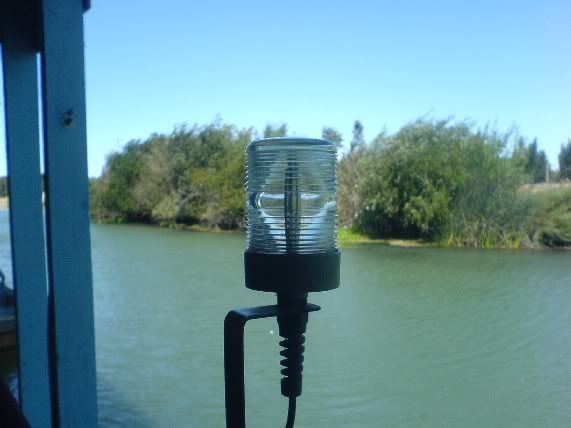
DSC00865a.jpg


This weekend I replaced the original Davis Instruments incandescent bulb (still working) with a LED replacement from Marine Beam. The Megalight was several times brighter with the LED replacement and according to specs: pulled nearly half the amp draw (.060 amps).

OEM incandescent bulb
DSC00858a.jpg


Marine Beam LED replacement bulb
DSC00861a.jpg


These are cellphone photos taken about five minutes apart. The LED replacement light has a higher color temperature and actually looks white/blue. I could look at the original bulb comfortably from a distance of six feet. The LED version was too bright to look at for long.

Boatfix sells the Mega-Light:
http://www.boatfix.com/shop3/store/listitems.asp?idCategory=445

Details on Mega-Light models:
http://www.davisnet.com/marine/products/lighting.asp

Marine Beam LED replacement bulb:
http://www.marinebeam.com/dameledre.html

Important Note: There are three models of the Mega-Light. Use the Mega-Light Masthead model if you want a hard-wired installation. It comes with 12" of wire for hook-ups. The Masthead model is shown further down this thead.

The Mega-Light shown above is the Utility model and it comes wired with a 12-volt plug. The cable on the 12-volt plug models of the Mega-Light have very tiny gauge wire that is more difficult to use for making electrical connections. You can use the Utility model for a hard-wired installation as I did but during the wiring you will wish you had the Masthead model instead.
 
Marine Beam says the same lamp fits "chart lamps from Hella, Scandvik, and others that use a miniature bayonet bulb."
 
Earlier in the month an RO asked me on another thread about possible RF issues from the Marinebeam line of LED bulb replacements, "I do not see any data at the Marine Beam sight about RF interferance. Using Pulse Width Modulation will create RF and interfere with radio reception."

Marinebeam LED arrays replace most of the commonly used incandescent and halogen lights used on boats and feature built-in current regulation with an IC that uses PWM technology. Marinebeam makes the following statement on their website:

From "Idiot's Guide: What You Need To Know About Buying LED Cluster Lighting For Your Yacht" Marinebeam states their products are CE approved and that "Care must be taken in the design of these switching circuits to avoid any RF or EMI. The introduction of LEDs into the automotive and cell phone sectors has produced robust designs and filtering methods for reducing EMI and RF issues below the strict European Union (CE) thresholds."

I got a chance to use the Marinebeam LED last night and tested for RF interference against a VHF marine radio, cell phone, depth sounder, digital TV, broadcast FM and AM radio and HF radio 1.65 Mhz through 30 Mhz.

There was no RF interference from the Marinebeam LED.
 
Thank you for the information on the RF yzer. I think I will replace my faulty Dr.Led and purchase both Dr.Led and Marinebeam and compare them.
 
My pleasure.

The harbormaster saw my new Marinebeam and was blown away. He said "What's that blue light?" and thought it was HID. The cool white that Marinebeam uses on nav lights (they have warm white for interior use) is more blue that any white LEDs I've seen. Makes a heck of a nav light.

The Mega-Light has a well-designed fresnel lens and that concentrates the output into a horizonal plane quite a bit.
 
A blue light is not a white light as required by the rules. I wonder if there would be problems should an accident occur.
 
Yzer, if the Mega Lights are used to replace your Red & Green Navigation lights do you get the impression that the very bright colors may be confused for other type of lighting? This could cause a dangerous mistake in collision avoidance?
 
quote:

Originally posted by Les Hall

A blue light is not a white light as required by the rules. I wonder if there would be problems should an accident occur.


That's what I was thinking. It's great that it is brighter and uses less power. I have seen a lot of very dim lights on small fishing boats at early hours of the morning.
 
Marinebeam recommends the following. Their cool white is shaded toward blue for maximum range and their warm white is more narrow in color bandwidwidth than incandescent bulbs.

1. Bi-color light that uses one bulb: use warm white LED, but the colors will change a little from what they were with incandescent.

2. For green and red nav lights that use individual bulbs: put red LEDs in red lights and green LEDs in greens.

3. For white lights where maximum range is desirable, use the cool white.

Myself, I have old lights on the boat that use auto tail-light type incandescent bulbs with glass lenses. These things have a jewel-like light I don't want to change so I've stuck with the old incandescent bulbs. I even align the single incandescent bulb vertically in the old bi-color fresnel lamp to get the best effect.
 
yzer, I had the Perko LED all-around ( bright! ), and yes it was more blue than an incandescent, but it was very much still a white light.

The lighting units you mention meet CL regs, but does the "white" meet the USCG ruling relating to color temp/color? If it is "quite blue", I'll bet it does not.

---

FWIW: In the past, and I believe that it is still true, that white LEDs were actually quite different from single color LEDs, red for example. They achieve the "white" color in much the same way as a fluorescent tube; with phosphors. They then produce a LED with strong UV output and let the phosphors do the work. This corrects the color output, but reduces the light intensity, which is why the brightest LEDs tend toward the blue end of the spectrum. ( This may have changed, but I am unaware of it happening. )
 
"Quite blue" compared to other LED white lights. I would definitely call the Marinebeam cool white LEDs a white light and not a blue light. My harbormaster's comment wasn't meant to be definitive.

From what I've learned, USCG approves only complete marine lamps: the fixture and bulb together. They do not approve the light bulbs by themselves (incandescent or LED). You are on your own when you replace any light bulb in a USCG approved light fixture.

As long as the lumen rating for the bulb is equal to or greater than the OEM bulb and the color is correct, you should be OK.
 
I only have 2 lights on my vessel that are not LED. With over 40 fixtures and all my navigation lights being LED none seem to affect my ham radio set up. They definately do not interfere with my VHF radios, FRS radios or Class B AIS transponder. I have everything from Perko's to Acua-signal LEDs. Going on 3 years and I haven't had an LED failure. This year I replaced my spreader lights with high power LED fixtures they are brighter than the old Halogens that drew 10 amps each the new pair draw 3.6 amps. I have been sold on LEDs since I replaced my overhead accent interior lights 3 years ago. It didn't take long before I found exact replacement fixtures and replaced every light fixture. The 2 lights that are not LED are a small reading lamp near the sette that runs off 110VAC with a small appliance 40 watt bulb and my spotlight on the bow pulpit.
Bill
 
Yzar; I believe you are correct with Navigation lights needing to be USCG approved fixtures. That is why I replaced all my navigation lights with USCG approved fixtures. The real positive is these are sealled assembly's and will probably outlast the boat.
Bill
 
Wow! Great info, Dan, and very timely, too. I've been looking for a quality LED anchor light with photocell on/off. Thanks for the great post!
 
I got a nice email from Jeff Field of Marinebeam last weekend. He read this post on BoaterEd and contacted me. Here is an excerpt from his email re: COLREGS and white light color temperature.

1) The light is about 6200-6500k max, which is considered "daylight" or "cool" white by CIE, and is about the same color temp as daylight on an overcast day. So while it is not technically "blue", it certainly is closer to bordering the blue than yellow. See the color chart below. The color temp varies slightly batch to batch, but we use bin-select LEDs to lessen the variation. We use cool white because it is about 15% brighter than the warm white. It is also much more noticeable I think.
300px-PlanckianLocus.png

2) The color does indeed meet with the COLREGS colorspace coordinates for a white source. It will also exceed the 1nm and 2nm requirements for anchor lighting for <12M and >12M (<20M) recreational craft.
3) The Davis Engineer that designed the fresnel lens came by our booth at Annapolis after dozens of people stopped by their booth to tell them about our LED. He continued to send us customers throughout the show, which was a good stamp of approval, I think. Because they have to go through another certification process if they change the light-source, they are happy to just send people our way.
4) Cool white should never be used behind a colored lens, for a host of reasons. On boats over 39' there are also issues using warm white behind colored lenses.


I invited Jeff to sign up on BE so he could provide his expertise in the field of marine LEDs. I hope he will he will be chipping here sometime soon.
 
Thanks, yzer. I've ordered mine and just have to figure out how to mount the light on my 15 inch stainless mast on top of my radar mast.

Photo0192.jpg


I see it comes with a mounting bracket, but will need to set it atop the mast. Any suggestions, yzer?
 
I faced the same type of problem because I wanted to mount the Mega-Light on top of the cockpit canvas.

There is an attachment nut at the base of the Mega-Light that will allow you to make up another bracket.

I bought some 1" wide brass stock at the hardware store and made a new L-shaped bracket that has a bimini clamp on one end and the Mega-Light on another. With a vise and a rubber mallet the brass was very easy to shape including a half twist and sharp right angles. Brass is also easy to drill and paint. It should be rigid enough to replace the tubular mast with a tall bolt-on brass bracket.

There are also other flat, L-shaped, tubular and square materials at a good hardware store including stainless and aluminum.

An easier way may be to leave the mast as is, remove the old fixture and use a shorter L-bracket to bolt the Mega-Light to the tubular stainless. You will need a plastic endcap for the tubing.

There may be other ways to stick the Mega-Light onto that mast depending on how the fixture is mounted but nothing beats actually taking it down and messing around with it for a while. I enjoy doing boat projects like this.

My brother-in-law has a Mega-Light mounted on top of an existing Perko-style anchor light with a tubular steel base. I'll call him this weekend and see how he did it or take a good look at it at the marina tomorrow. I think he used at least part of the existing lamp fixture to do it.
 
Dan, is your BIL at Spindrift, too? Maybe I can stop by and look at both when the parts come in. I'll probably be down to Riverboat next weekend. Will you be around?
 
Yes, he's at Spindrift too. I've planned on going out on the water for a Fri-Mon four-day next weekend but I'll be there tomorrow and will probably stop by the marina on the following weekend. I'd be happy to meet you there.
 
Back
Top