
You are using an out of date browser. It may not display this or other websites correctly.
You should upgrade or use an alternative browser.
You should upgrade or use an alternative browser.
Following Seas
- Thread starter walterv
- Start date
Capt. Bill1
Active member
- Joined
- Jan 1, 2000
- RO Number
- 2017
- Messages
- 6,127
Some boats just don't like them. What kind of problems are you having? To much wandering?
- Joined
- Jan 1, 2000
- RO Number
- 3238
- Messages
- 4,831
"They all do that."
Well, some more than others... However a true displacement hull will have much less trouble than a full planing hull. If you are somewhere in between, then your results will be also.
Also, trim tabs should be fully retracted in a following sea.
Tell us more about the problem, and type of hull.
Well, some more than others... However a true displacement hull will have much less trouble than a full planing hull. If you are somewhere in between, then your results will be also.
Also, trim tabs should be fully retracted in a following sea.
Tell us more about the problem, and type of hull.
I have a 26' Campion Toba, and she like quarter stern seas the best. A little throttle work......backing off on the downward side of a wave, and throttling up when pointing up a wave. It seems to be less demanding on the boat itself..a bit harder on the captain though hehehe Taking seas bow on seems to give me less control...I'm hitting them head on as opposed to "riding" them up and down and having a bit of control. Now she's a heavier boat for her size, about 4 tons loaded...so that may factor in. As a side note...you know you've hit big enough seas when the admiral starts to use language not normally used........I found that out!!!  On another note...the first thing she has started doing is look at bigger boats. Now that's a PLUS!! I will have to thank the sea gods for that one!
Let's take a look see....how many captains would rather take seas on the stern, quarter stern or bow on? Length of the boat is probably the most applicable factor here....longer boats will take heavier seas, just like a longer wheel base vehicle rides better than a shorter wheel base vehicle. Not meant to hijack the thread...but I'm thinking many prefer the first or second choice. I may be wrong though.
On another note...the first thing she has started doing is look at bigger boats. Now that's a PLUS!! I will have to thank the sea gods for that one!Let's take a look see....how many captains would rather take seas on the stern, quarter stern or bow on? Length of the boat is probably the most applicable factor here....longer boats will take heavier seas, just like a longer wheel base vehicle rides better than a shorter wheel base vehicle. Not meant to hijack the thread...but I'm thinking many prefer the first or second choice. I may be wrong though.
- Joined
- Jan 1, 2000
- RO Number
- 3238
- Messages
- 4,831
I tack downwind. 
Honestly, most boats other than true displacement hulls ( mostly sailboats ) prefer to tak a following sea on the aft quarter, not directly from astern. For that matter, dead-on head seas are a pain, too. Usually tacking a bit upwind will provide a better ride.
Honestly, most boats other than true displacement hulls ( mostly sailboats ) prefer to tak a following sea on the aft quarter, not directly from astern. For that matter, dead-on head seas are a pain, too. Usually tacking a bit upwind will provide a better ride.

- Joined
- May 14, 2001
- RO Number
- 4570
- Messages
- 1,383
I don't mind a following sea ... I find "tabs up" helps as does careful use of the throttle ... in really big seas, try and pick a wave and use power to stay on the back of it. In moderate seas you can use a little more power and go "over the top", being careful not to "bury the bow". As always use a little common sense as to the capability of your boat and your own experience. The size of your boat will dictate the best way to handle any kind of sea condition.

- Joined
- Sep 16, 2003
- RO Number
- 12212
- Messages
- 12,221
at what speed? planning or non planning? the boat will handle very differently obviously.
in any case, with following seas, many boats will give you a real work out at the wheel... usually you can forget the AP, it's useless.
in any case, with following seas, many boats will give you a real work out at the wheel... usually you can forget the AP, it's useless.
Prospective
Active member
- Joined
- Sep 7, 2006
- RO Number
- 23085
- Messages
- 1,343
Contrary to what a novice like me might have thought, following seas are much worse than a head sea, at least in the boats I've had. Coming in from Cutty this past weekend we were in a 3-5ft following sea that was pretty tightly spaced. My problem was I couldn't stay between them and stay on plane, and going over them was causing engine cavitation and I was getting some vibration. The other problem I was having was without any tab I was riding too bow up for good visability. It will take some practice to figure out the most comfortable method. It may mean tacking and keeping the swell on the quarter.
to answer the original post. if the following seas are tall enough or spaced closely enough that you feel endangered by them you have two choices;
if the boat has enough speed and open water in front, run on the back side of the wave and dont try to crest it.
if the above is'nt possible, point the bow into the seas and run slowly adding throttle as needed for steerage as you crest the wave.
these two options apply only if the seas are large enough to put the boat in danger. as a footnote, taking large breaking seas on anything but straight on the bow, is to be avoided in most power boats.
anything smaller that is not a threat to the safety of the boat and crew is a comfort issue and best determined by the captain based on the boat, seas and wind.
quote:
Originally posted by vic33004
to answer the original post. if the following seas are tall enough or spaced closely enough that you feel endangered by them you have two choices;
if the boat has enough speed and open water in front, run on the back side of the wave and dont try to crest it.
if the above is'nt possible, point the bow into the seas and run slowly adding throttle as needed for steerage as you crest the wave.
these two options apply only if the seas are large enough to put the boat in danger. as a footnote, taking large breaking seas on anything but straight on the bow, is to be avoided in most power boats.
anything smaller that is not a threat to the safety of the boat and crew is a comfort issue and best determined by the captain based on the boat, seas and wind.
+1
My Hatteras has a big fat square butt and can be a real handful in following and quartering seas. As mentioned several times above, modulating speed to match conditions is the secret to success and sometimes you have to tack too. Still, as Pascal alluded to, there are times when even the autopilot whimpers and gives up anyway. If on your boat that means coming off plane, so be it.
George
Hatteras 56MY
Boston Whaler 130 Sport
George
Hatteras 56MY
Boston Whaler 130 Sport
quote:
Originally posted by PascalG
at what speed? planning or non planning? the boat will handle very differently obviously.
in any case, with following seas, many boats will give you a real work out at the wheel... usually you can forget the AP, it's useless.
In the case this weekend it was not on plain, it was coming in the Fire Island inlet, the rollers were big and not far apart.
So I guess the gig is to stay between the wave and ride the crest?
I don't like the feel of being pushed, very hard to control the boat when that happens
Capt. Bill1
Active member
- Joined
- Jan 1, 2000
- RO Number
- 2017
- Messages
- 6,127
As Perry mentions, ride the back of a wave and if you have to use the throttles to steer with. Going in to slow can be the worse thing you can do.
Also sometimes it's best to sit outside an inlet and watch the wave sets roll in. That way you can pick the timing of the set and set size you want to ride in with.
Also sometimes it's best to sit outside an inlet and watch the wave sets roll in. That way you can pick the timing of the set and set size you want to ride in with.
Trim Tabs 101: Bow down when the boat begins to pound in a head sea--and of course slow down to an appropriate speed. Bow up in following seas, i.e. make like you don't have tabs, you want them all the way up, so that the bow doesn't bury when a wave lifts the stern. You can use them to correct any tendency to list to one side or the other, but not in following seas--just leave them up. There are other uses for trim tabs, maybe the most common one is to counter bow rise when coming up on plane--that would be bow down until the boat comes up on plane and then bow up for max speed at given rpm assuming the water is smooth. Some boats actually run faster with some tab (bow down), but most boats go fastest with no tab deployment (i.e. bow up). To comment on the original post, riding the back of a wave is the best way to run in a following sea.
You have a lot of things changing when transiting FI or most inlets. As the channel shoals and or the channel narrows the waves become steeper and closer together.
All of that makes some inlets more difficult. The effects are worse if there is an onshore wind and ebbing tide. It is best to transit an inlet on the flood.
The square sterns on most powerboats allow an uneven lift and side force when a wave approaches from the stern quarter. That tends to push the stern in the direction of the wave.
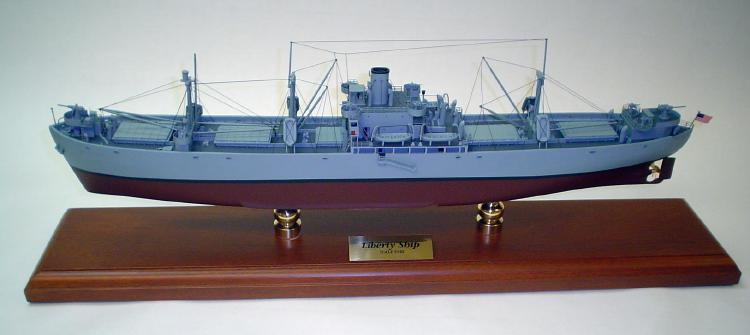
Sailboats and real trawlers with no deeply immersed transom will behave better but even they will do a corkscrew motion as a quartering wave passes. Canoe sterns were popular on some older boats to reduce the effect. Even today some passage maker yachts have sterns designs for quartering seas. Nothing much can be done with the design of planning boats because they need flat square sections aft. Look at the liberty ship model below and notice the canoe stern and narrow sections aft. Those were slow ships that had to take the waves as they came. The aft sections are even narrower than forward to decrease drag as well. Those fuller forward sections provided buoyancy to reduce burying the bow..
All of that makes some inlets more difficult. The effects are worse if there is an onshore wind and ebbing tide. It is best to transit an inlet on the flood.
The square sterns on most powerboats allow an uneven lift and side force when a wave approaches from the stern quarter. That tends to push the stern in the direction of the wave.
Sailboats and real trawlers with no deeply immersed transom will behave better but even they will do a corkscrew motion as a quartering wave passes. Canoe sterns were popular on some older boats to reduce the effect. Even today some passage maker yachts have sterns designs for quartering seas. Nothing much can be done with the design of planning boats because they need flat square sections aft. Look at the liberty ship model below and notice the canoe stern and narrow sections aft. Those were slow ships that had to take the waves as they came. The aft sections are even narrower than forward to decrease drag as well. Those fuller forward sections provided buoyancy to reduce burying the bow..
- Joined
- Sep 16, 2003
- RO Number
- 12212
- Messages
- 12,221
about tabs, in normal conditions it's not just speed, it's also fuel economy. on some boats, finding the right tab setting can save a few gallons an hour. At speed bow up is not the most economical. Typically at slow cruise (jsut on plane) you still need full tab down then if you accelerate beyond that speed, the drag created by the trim tab begins to increase and reducing the amount tab/raising the bow improves economy. Once you near WOT, tabs should be fully retractged. obviosly the specifics depend on the boat but you need to experiment and your GPS is the best tool. At slow speed (hull speed) leaving the tabs all the way down can cost you as much as 1/2 kt on the same fuel burn.
On some boats the rudders are too small to be effective at the slow speed you may need to run at in an inlet. It means you will need to steer fast and hard to keep the ride comfortable.
Offshore, with a little practice you can actually smooth out the roll by anticipating the boat motion. this is why human steering works better since the AP only reacts to heading changes and by that time it's too late.
Walter-
I hate the sensation too! I almost sold my boat thinking it was handling flaw until I spoke to some honest deep V guys that admited their boats do it too. I've grown much more comfortable with it following the advice above. In my boat- tabs up makes a HUGE difference. Then matching speed to the conditions and it tracks fine. BUT, get into the wrong conditions with the tabs down and the wrong speed and it feels like the boat could broach at any second. Not a fun feeling.
I hate the sensation too! I almost sold my boat thinking it was handling flaw until I spoke to some honest deep V guys that admited their boats do it too. I've grown much more comfortable with it following the advice above. In my boat- tabs up makes a HUGE difference. Then matching speed to the conditions and it tracks fine. BUT, get into the wrong conditions with the tabs down and the wrong speed and it feels like the boat could broach at any second. Not a fun feeling.