Just curious for the sake of bored discussion. Why was the outdrive ever invented and why has it been such an important part of boating for so long? I just sold my first boat ever owned and it had an outdrive. The maintenance on the drive was the devil incarnated in mechanical form. Granted I am talking about a wet salt slipped boat. If I trailered or had a lift I would feel much better about an outdrive. Why are not all boats inboards with transmissions and shafts? This seems like a much simpler set up with much less maintenance and about 50% less things that could go wrong. There must be something I am missing as it seems the outdrive was an evolutionary step backwards over an inboard.

You are using an out of date browser. It may not display this or other websites correctly.
You should upgrade or use an alternative browser.
You should upgrade or use an alternative browser.
Why???
- Thread starter Adjuster
- Start date
Mercrewser
Member
- Joined
- Jan 23, 2006
- RO Number
- 20025
- Messages
- 64
so newbies can drive
better effiency
faster
better effiency
faster
I'm not sure. I knew a guy who owned a 26 ft early fiberglass boat. The single engine was under the salon deck in the middle of the boat, but it had an outdrive. So it seemed to be an early use of an outboard. That boat could run through chop smoothly and turn on a dime. She handled extremely well---much better then my boat with the typical Merc sterndrive and could get on plane with six adults sitting in the cockpit area. I think having the engine near the center of gravity and the outdrive hanging off the transom was a great combo.
Trailerability, variable trim , shallower-running, more efficient level & side-directable thrust , 4-stroke engine mounted inboard for better balance than many O/B's & motor accessibilty when floating. I had 2 I/O's, but don't ever expect to do that again.
- Joined
- Jul 21, 2005
- RO Number
- 18340
- Messages
- 552
Better efficiency. Much smaller power package vs. inboards means more room in the boat.
In the words of Tim the Toolman Taylor. MORE POWER>>>>>
Here is the rest of the story.....http://www.rbbi.com/folders/pat/isd.htm
I for one am glad it happened. The advances on outboard technology due to I/O are a boon to the consumer. If I could get Saint Max in an outboard version today, no question.
Here is the rest of the story.....http://www.rbbi.com/folders/pat/isd.htm
I for one am glad it happened. The advances on outboard technology due to I/O are a boon to the consumer. If I could get Saint Max in an outboard version today, no question.
quote:
Originally posted by b_arrington
Better efficiency. Much smaller power package vs. inboards means more room in the boat.
???????
The engine is still in the boat.
G
quote:
Originally posted by Adjuster
How does it obtain better efficiency? It would seem from all the mechanicals in an outdrive that it would be much less efficient than a straight drive.
Efficiency is achieved through better thrust angle. Even the best inboard engine setup has an angle of the drive shaft relative to the center line of the boat.
G

- Joined
- Sep 16, 2003
- RO Number
- 12212
- Messages
- 12,221
Let me guess, you were the proud owner of a Mercruiser outdrive? 
yep... with a stern drive thrust is applied horizontally instead of at an angle... As others have mentioned on smaller boat it's easier to put the engine against the transom (under a seat, cockpit, sunpad) than further forward where you need cabin space.
and obviously a stern drive allow for shallow water operation...
Yep Pascal it was a Merc Pre Alpha. Let me come clean a little bit so I don't seem so much a downer on outdrives. Although in my opinion maintenance on the outdrive (bellows(3), shift cable, zincs, oil, trim rams under water, various seals, corrosion, an addictive drug for barnacles)is excessive for the value you get from this type of drive. My drive never failed me once. Spun a few props but even then I was able to limp home.
I always assumed it was space efficiency for small boats. You ever been on a performance ski boat? The inboard provides a great powerful ride that gets you out of the hole quickly and produces a courteous little wake… but man, does it take up a lot of room sitting in the middle of the cockpit!
But now, the engine for some I/Os is back amidship. Some fishing layouts, like center consoles, allow the engine to fit under the console and the outdrive is driven by a "Jackshaft." I believe it's MerC and that they also have an inline engine that lays on its side.
- Joined
- Jul 21, 2005
- RO Number
- 18340
- Messages
- 552
quote:
Originally posted by gcolton
quote:
Originally posted by b_arrington
Better efficiency. Much smaller power package vs. inboards means more room in the boat.
???????
The engine is still in the boat.
G
As already mentioned, the engine for a stern drive is placed pretty much at the transom of the boat. The drive shaft runs a short distance directly through the transom.
On an inboard the engine must be placed basically in the middle of the boat. The shaft runs some distance inside the boat, which must me accessible. The space required for the engine can't be used for something like an aft cabin or storage areas.
An example. Compare two boats with similar missions from the same brand: Sea Ray 340 Amberjack and a 290 Amberjack of the same vintage (say 1998). The 340 has twin inboards. It has only a v-berth due to the engine being amidships. The 290 is 5 feet shorter with twin stern drives. The engine is at the end of the boat, with a smaller engine room. As a result it can sleep 6 (v-berth, convertible dinette, aft cabin).
- Joined
- Jul 21, 2005
- RO Number
- 18340
- Messages
- 552
quote:
Originally posted by j-d
But now, the engine for some I/Os is back amidship. Some fishing layouts, like center consoles, allow the engine to fit under the console and the outdrive is driven by a "Jackshaft." I believe it's MerC and that they also have an inline engine that lays on its side.
jd - sounds like you are describing a v-drive. The layout looks like this:
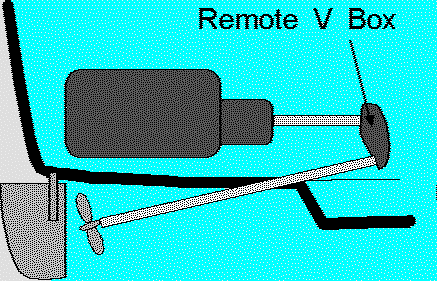
This type of engine is often an optional power package in lieu of a stern drive. The same hull design can be used while offering multiple propulsion options. It's a middle-ground between a stern drive and a traditional inboard. You get the compact space requirements of a stern drive, but like an inboard doesn't have the associated maintenance issues of a stern drive. V-drives are also more maneuverable around the docks and offer better seakeeping in heavy seas vs. stern drives.
There are some downsides to a v-drive. Usually the are available only in pairs (I've never seen a single v-drive option). The installation of a v-drive is usually more cramped than a stern drive, and maintenance access can be more difficult as a result. (The engine is flipped, but you need to leave room for the jackshaft and transmission.) You also get the reduced efficiency of an inboard because the angled shaft. Top end and range is generally lower with v-drives vs. stern drives.